

Mental Metal Academy – Lesson #2
The Complete Beginner’s Guide
By Mental Metal | Mental Metal Detecting
“Learn how to properly adjust your metal detector’s sensitivity for maximum performance without sacrificing stability.”
Welcome to Lesson #2
Welcome back to the Mental Metal Academy!
In Lesson #1, we learned how Discrimination helps decide which targets your detector responds to.
Now it’s time to explore one of the most misunderstood settings on any metal detector—Sensitivity.
Many beginners believe that turning sensitivity to the maximum setting will always help them find deeper targets. While that sounds logical, it’s one of the biggest misconceptions in metal detecting.
Learning how sensitivity really works will help you build confidence, reduce frustrating false signals, and recover more good finds.
🎥 Watch the Full Lesson
What Is Sensitivity?
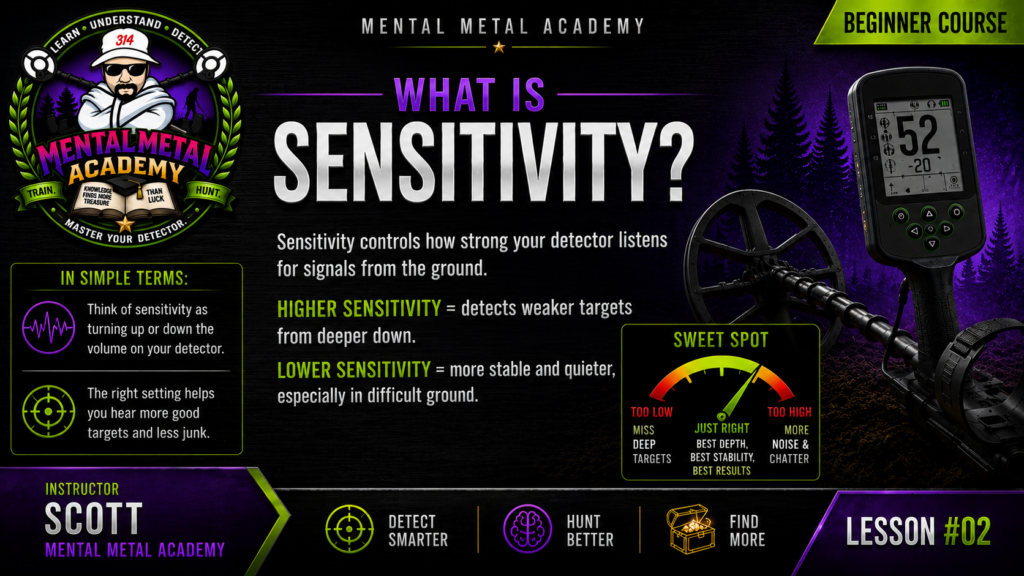
Sensitivity controls how strongly your metal detector responds to signals coming from the ground.
Think of it like the volume control on a microphone.
Turning it up allows the detector to respond to weaker signals—but it also makes it more likely to respond to unwanted electrical interference, highly mineralized soil, and tiny pieces of metal trash.
Higher sensitivity doesn’t simply mean “better.”
It means more responsive.
What Does Sensitivity Actually Do?
Increasing sensitivity can help your detector respond to:
- Smaller targets
- Deeper targets under the right conditions
- Weak signals that might otherwise go unnoticed
However, increasing sensitivity also increases the likelihood of detecting:
- Electrical interference (EMI)
- Mineralized ground
- Hot rocks
- Tiny foil
- Small iron fragments
The goal isn’t to run the highest sensitivity possible.
The goal is to run the highest stable sensitivity for the conditions you’re hunting.
The Biggest Beginner Mistake
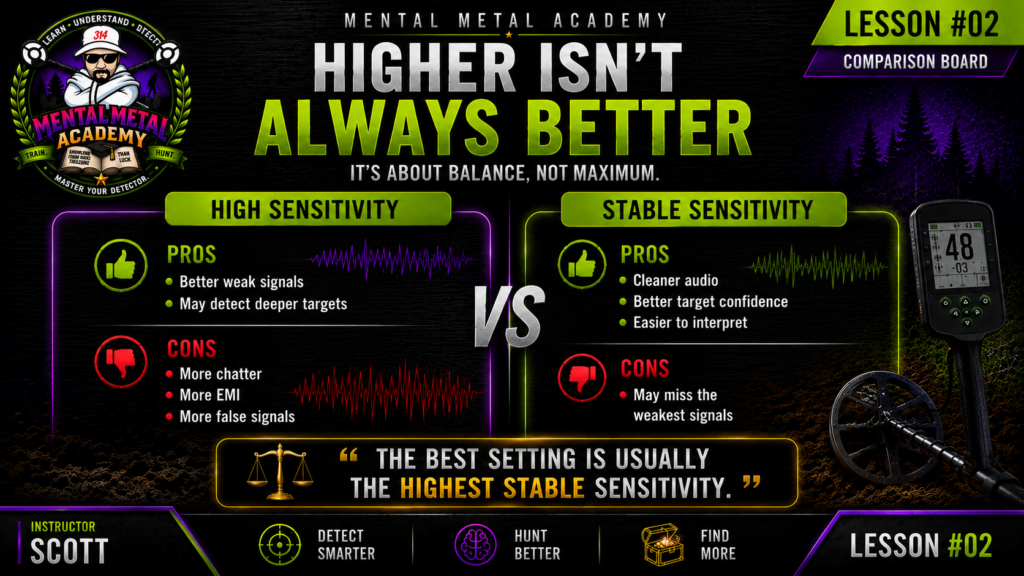
One of the most common mistakes beginners make is immediately setting their detector to maximum sensitivity.
Unfortunately, that often causes:
- Constant chatter
- False signals
- Jumping Target IDs
- Frustration
Many people mistake instability for “more power.”
In reality, an unstable detector often causes you to miss good targets because it’s difficult to separate genuine targets from background noise.
Signs Your Sensitivity Is Too High
If your detector is:
- Beeping randomly
- Producing unstable Target IDs
- Chattering continuously
- Becoming difficult to pinpoint
your sensitivity may simply be set too high for the conditions.
Reducing sensitivity slightly often results in a quieter, more predictable detector that allows good targets to stand out.
When Should You Increase Sensitivity?
Higher sensitivity works best when:
- The site has very little EMI.
- The soil is relatively mild.
- You’re searching for smaller targets.
- You’re searching for deeper targets.
- Your detector remains stable.
Always increase sensitivity gradually and pay attention to how the detector responds.
When Should You Lower Sensitivity?
Lower sensitivity may actually improve your hunting experience when:
- EMI causes excessive chatter.
- The soil is heavily mineralized.
- You’re hunting around power lines.
- You’re detecting near underground utilities.
- Your detector becomes unstable.
Remember:
A stable detector is usually a more productive detector.
⭐ Mental Metal Tip

Don’t chase the highest number… chase the most stable detector.
A detector that runs smoothly and quietly will often recover more good targets than one that’s constantly producing false signals.
🥾 In the Field
Imagine you’re hunting an old city park.
You increase your sensitivity to the maximum setting because you want to find deeper coins. Instead, your detector starts chattering constantly and the Target IDs jump all over the screen.
Rather than fighting the machine, lower the sensitivity a few points until it becomes stable again.
Suddenly, those random noises disappear—and the next repeatable signal turns out to be an old silver coin.
Sometimes less sensitivity actually helps you hear more good targets.
Common Beginner Questions
Does maximum sensitivity always give more depth?
No.
Higher sensitivity can improve response to weaker targets under ideal conditions, but once the detector becomes unstable, overall performance often suffers.
Why is my detector making random noises?

Random chatter is frequently caused by:
- Sensitivity set too high
- Electrical interference (EMI)
- Difficult ground conditions
Should I always use the factory default sensitivity?
Factory settings are an excellent starting point, but they’re designed to work in many different environments—not necessarily your specific site.
Adjust sensitivity based on the conditions you’re hunting.
Can lowering sensitivity help me find more targets?
Absolutely.
A quieter detector often makes it easier to recognize genuine targets that might otherwise be hidden by constant chatter.
🔑 Key Takeaways
- Sensitivity controls how responsive your detector is to weak signals.
- Higher sensitivity isn’t always better.
- Too much sensitivity can create false signals and unstable Target IDs.
- The best setting is the highest stable sensitivity for your site.
- Adjust sensitivity based on ground conditions and electrical interference.
- A stable detector almost always produces better results than a noisy one.
Continue Your Academy Journey
Read the next lessons:
- Lesson #1 – Discrimination
- Lesson #3 – Recovery Speed
- Lesson #4 – Ground Balance
- Lesson #5 – Search Modes
- Lesson #6 – Noise Cancel
- Lesson #7 – Search Coils
Each lesson builds on the previous one to help you understand why your detector behaves the way it does—not just which buttons to press.
Final Thoughts
Sensitivity is one of the most powerful settings on your metal detector—but it’s also one of the easiest to misunderstand.
The goal isn’t to run your detector at the highest setting possible.
The goal is to find the highest setting that keeps your detector stable, predictable, and capable of identifying good targets with confidence.
Learning that balance is one of the biggest steps toward becoming a successful detectorist.
🎥 Watch the Full Lesson
Enjoyed This Lesson?
If this guide helped you better understand metal detector sensitivity:
- 👍 Subscribe to Mental Metal Detecting on YouTube.
- 🎓 Follow the Mental Metal Academy, with a new lesson every Saturday.
- 📄 Become a YouTube Alliance Member or Patreon Silver Member (or higher) to access exclusive downloadable Field Cards.
Get Entered into Our Monthly Detector Giveaway

Disclaimer: Mental Metal Detecting is a proud participant in the Amazon Services LLC Associates Program, an affiliate advertising program designed to provide a means for sites to earn advertising fees by advertising and linking to Amazon.com. Mental Metal Detecting also participates in affiliate programs with Bluehost, ShareASale, and other sites. Mental Metal Detecting is compensated for referring traffic and business to these companies.
Recent Posts
What Is Recovery Speed on a Metal Detector? The Complete Beginner's Guide
Part of the Mental Metal Academy Series Welcome to Mental Metal Academy Have you ever swung your metal detector over a patch of ground and wondered why your hunting partner found a coin...
What is Discrimination on a Metal Detector? The Complete Beginner's Guide
How Metal Detector Discrimination Really Works By Mental Metal | Mental Metal Detecting "Learn when to use discrimination, when to avoid it, and how to recover more valuable targets without...