
Part of the Mental Metal Academy Series
Welcome to Mental Metal Academy
Have you ever swung your metal detector over a patch of ground and wondered why your hunting partner found a coin that you completely missed?
It may not have been luck.
It may have been Recovery Speed.
Recovery Speed is one of the most important settings on a modern metal detector because it determines how quickly your detector can respond to one target and be ready to detect the next one.
In this lesson, you’ll learn what Recovery Speed is, how it affects target separation and depth, and how to choose the right setting for the type of site you’re hunting.
Watch the Lesson
What Is Recovery Speed?
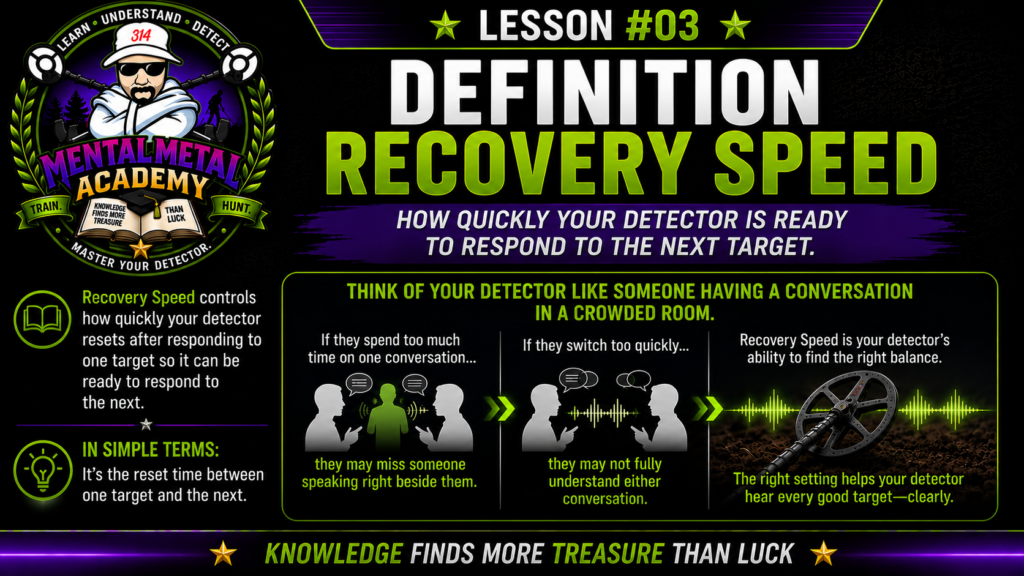
Recovery Speed (sometimes called Reactivity, Recovery Rate, or a similar term depending on the manufacturer) is the speed at which your detector resets after responding to a target.
Imagine sweeping your search coil across the ground.
Your detector encounters a rusty nail…
A few inches later, there’s an old silver dime…
Then another nail.
If your detector resets quickly, it has a better chance of identifying each object as a separate target.
If it resets too slowly, those targets may blend together, making it more difficult to recognize the good target hidden among the junk.
Think of Recovery Speed like windshield wipers. If they move too slowly during a heavy rain, your visibility suffers. When they move at the right speed for the conditions, you can clearly see what’s ahead.
Why Recovery Speed Matters
Recovery Speed affects how well your detector separates nearby targets.
A faster Recovery Speed helps in areas with lots of trash because the detector can recover more quickly between closely spaced objects.
A slower Recovery Speed allows the detector to spend a little more time analyzing each signal, which may improve detection depth in cleaner locations where targets are farther apart.
The key is choosing a setting that matches the conditions—not assuming that higher or lower is always better.
Fast vs. Slow Recovery Speed
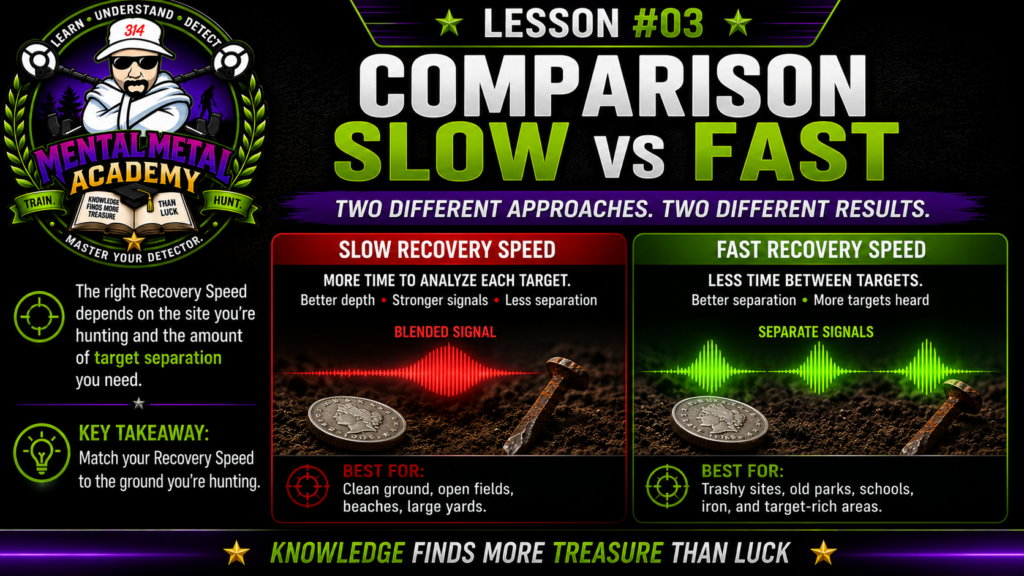
Faster Recovery Speed
Best for:
- Parks with modern trash
- Old home sites with iron contamination
- Fairgrounds
- Demolition sites
- Areas with closely spaced targets
Advantages:
- Better target separation
- Faster response between nearby objects
- Reduced target masking in trashy areas
Trade-offs:
- May reduce maximum detection depth compared to slower settings, depending on the detector and conditions.
Slower Recovery Speed
Best for:
- Open farm fields
- Pastures
- Beaches with sparse targets
- Woods
- Cleaner hunting locations
Advantages:
- May provide additional depth in suitable conditions
- Allows the detector more time to analyze each target
Trade-offs:
- Closely spaced targets may blend together more easily.
Common Recovery Speed Mistakes
One of the most common misconceptions is that the highest Recovery Speed is always the best choice.
In reality, every setting involves a balance between target separation and the amount of time the detector spends evaluating a signal.
Other common mistakes include:
- Never changing the setting regardless of the site
- Using extremely fast settings in open fields
- Assuming Recovery Speed alone solves target masking
- Changing Recovery Speed without understanding how it affects detector behavior
How to Choose the Right Recovery Speed
Ask yourself a few simple questions:
- Is the site full of iron and modern trash?
- Are good targets likely to be close together?
- Is the ground relatively clean?
- Am I searching for maximum separation or maximum depth?
If you’re hunting an old park filled with pull tabs, bottle caps, and nails, a faster Recovery Speed is often helpful.
If you’re searching a large farm field with very little trash, a slower setting may allow your detector to analyze each target more thoroughly.
As always, refer to your detector’s manual for the available Recovery Speed settings and recommendations for your specific model.
💡 Mental Metal Tip

Recovery Speed isn’t about finding more targets—it’s about separating the targets that are already there.
Choosing the right setting for the conditions often matters more than simply selecting the fastest or slowest option.
🥾 In the Field
You’re searching around the foundation of an old farmhouse.
Every swing produces multiple signals because the area is filled with square nails and decades of iron debris.
After increasing your Recovery Speed, the detector begins separating those closely spaced targets more clearly.
Among the iron signals, you hear a clean, repeatable tone.
A few inches later, you recover an old silver dime that had been partially masked by nearby nails.
The coin was always there.
Your detector simply needed enough recovery speed to distinguish it from the surrounding iron.
Frequently Asked Questions
Does a higher Recovery Speed always find more targets?
Not necessarily. A higher setting improves target separation in many trashy locations, but it isn’t automatically the best choice for every site.
Does Recovery Speed affect depth?
It can. On many detectors, slower settings may provide additional depth in cleaner conditions, while faster settings prioritize target separation. The exact behavior depends on the detector model and hunting conditions.
Should I change Recovery Speed during a hunt?
Yes—if the site conditions change. Moving from a clean pasture into an iron-infested home site is a good example of when adjusting Recovery Speed may improve performance.
🔑 Key Takeaways
- Recovery Speed controls how quickly your detector resets between targets.
- Faster settings generally improve target separation in trashy areas.
- Slower settings may offer advantages in cleaner ground.
- Match your Recovery Speed to the site you’re hunting.
- Practice with different settings to learn how your detector responds.
Continue Your Academy Training
Recovery Speed is just one of the settings that helps your detector perform at its best.
As you continue through the Mental Metal Academy, you’ll learn how settings like Ground Balance, Search Modes, Noise Cancel, and Target Tones all work together to improve your success in the field.
🎓 Mental Metal Academy
The Mental Metal Academy is a free educational series designed to help detectorists understand their machines instead of simply copying settings. Each lesson builds on the previous one, making it easy to become a more knowledgeable and successful metal detectorist. The series of lessons in video format can be found the Mental Metal Detecting Youtube Channel.
Join the Mental Metal Community
Want to take your learning even further?
Members receive:
- Downloadable Mental Metal Academy Field Cards
- Exclusive educational content
- Monthly Zoom sessions
- Early access to new lessons
- Eligibility for the Monthly Metal Detector Giveaway by joining Patreon at the Silver Tier or higher or becoming a Mental Metal YouTube Alliance Member before the 25th of each month.
Enter to Win a Detector of Your Choice (Limitations Apply)

Disclaimer: Mental Metal Detecting is a proud participant in the Amazon Services LLC Associates Program, an affiliate advertising program designed to provide a means for sites to earn advertising fees by advertising and linking to Amazon.com. Mental Metal Detecting also participates in affiliate programs with Bluehost, ShareASale, and other sites. Mental Metal Detecting is compensated for referring traffic and business to these companies.
Recent Posts
Mental Metal Academy – Lesson #2 The Complete Beginner's Guide By Mental Metal | Mental Metal Detecting "Learn how to properly adjust your metal detector's sensitivity for maximum...
What is Discrimination on a Metal Detector? The Complete Beginner's Guide
How Metal Detector Discrimination Really Works By Mental Metal | Mental Metal Detecting "Learn when to use discrimination, when to avoid it, and how to recover more valuable targets without...